

What Is Myofunctional Therapy and How Can It Help Your Child?
Your child sleeps with their mouth open. Their teacher has mentioned something about their speech. And at night, you can hear them snoring from down the hall. Separately, each of these things might seem minor. Just a phase, maybe. But together, they could point to something worth looking into: how your child’s mouth, tongue, and facial muscles are working.
These muscles guide how your child breathes, swallows, speaks, and how their jaw develops over time. When they’re not functioning as they should, the effects show up in ways that can seem completely unrelated. That classic open mouth posture, disrupted sleep, unclear speech, misaligned teeth, and restless behaviour.
Myofunctional Therapy (MFT) is a structured, non-invasive treatment designed to address exactly this. It’s not braces. It’s not surgery. It’s a targeted program of exercises that retrains and strengthens the orofacial muscles so they work the way they’re supposed to.
This article covers how oral myofunctional therapy can help, what it involves, the signs your child may benefit from it, why early intervention matters, and how KB Village Dental’s early intervention approach can help.
What Is Myofunctional Therapy?
Think of it like physiotherapy, but for the mouth’s muscles.
MFT is a personalised program of structured exercises that retrains and strengthens the muscles of the face, lips, tongue, and jaw. These muscles are responsible for some of the most fundamental things your child does every day: breathing, swallowing, chewing, and forming sounds. When any of these functions are off, even slightly, it can affect your child’s oral development in ways that aren’t always obvious at first.
At KB Village Dental, MFT programs for children are provided by Oral Health Therapist Mirna Yousif. Mirna designs each program to suit the child’s specific needs and growth stage. The program looks different for a five-year-old than for a nine-year-old.
MFT is not an orthodontic treatment, and it doesn’t replace one. But addressing the underlying muscle habits that drive structural problems can reduce the complexity of any orthodontic treatment your child may need down the track.
Signs Your Child May Benefit from Myofunctional Therapy

Parents usually notice something before anyone puts a name to it. It might be that your child always seems tired despite a full night’s sleep. Or their teacher has mentioned their speech is hard to follow. Or you’ve noticed they are often open-mouth breathing at the dinner table, watching TV, or during the night.
These things don’t always look like a dental problem. But they can all connect back to how the muscles of the mouth, tongue, and face are working.
The signs worth paying attention to:
- Mouth breathing at rest or during sleep
- Snoring or sleeping with the mouth open
- A restless night with poor sleep quality that never seems to result in a rested child
- Thumb sucking that continues past the toddler years
- Tongue thrusting, reverse swallowing, or difficulty with certain foods
- Teeth that don’t meet properly, or an open bite
- Speech that’s unclear or hard to place
- Poor posture
- Obstructive sleep apnoea
- Trouble focusing at school
- Active tongue tie, or a history of tongue tie release with no improvement in the oral posture
Any one of these on its own might be nothing. But if you’re seeing a few of them together, it’s worth getting a professional opinion rather than waiting. Some habits do resolve on their own, but others quietly shape a child’s jaw development, and by the time the effects are visible, they’re harder to address. A quick assessment tells you which camp you’re in. That’s a much better position than guessing.
What Does Myofunctional Therapy Actually Involve?
One of the most common questions parents ask is: What will this actually look like for my child?
MFT at KB Village Dental targets three key muscle groups: the tongue muscles (responsible for tongue position and movement), the lip muscles (which support lip sealing and proper swallowing), and the jaw and TMJ muscles (which influence balanced jaw growth and stability).
Treatment is delivered as a sequential, personalised exercise program. Sessions are short, non-invasive, and age-appropriate. There are no drills, no moulds, and nothing your child should find distressing. Between appointments, your child practises the exercises at home. This is actually a key part of how MFT works: the goal isn’t just what happens in the chair, but the patterns your child carries into daily life.
Treatment timeframes vary depending on the child’s age, the habits being addressed, and the consistency with which the exercises are performed. Mirna can walk you through what to expect during an initial consultation.
Why Early Intervention With MFT Can Benefit Your Child Long-Term
Most information you’ll find online about myofunctional therapy stops at listing the benefits. But the reason timing matters goes a step further.
Breathing, tongue position, and swallowing. These all apply force to a child’s growing jaw and face. When the patterns are wrong, particularly mouth breathing, it’s not just a functional problem. Over time, it can change how the jaw grows and cause myofunctional disorders that are hard to correct.
Children’s faces and jaws are actively developing during the primary and early mixed dentition years, roughly ages 4 to 9. MFT during this window works with that development, guiding the muscles of the mouth and face in the right direction while helping your child develop new habits to support their overall health and upper airway function. Habits addressed while the jaw is still forming are far easier to correct than the structural changes they can cause if left in place.
The downstream benefits are real. Better nasal breathing supports better sleep. Better sleep has a measurable effect on concentration, behaviour, and emotional regulation. Correcting tongue thrust and improving muscle coordination supports clearer speech and more comfortable eating. Early MFT can reduce the complexity of future orthodontic treatment, not by eliminating the need for braces, but by improving the starting position to prevent the severity of crowded teeth.
The earlier the muscle habits are corrected, the less structural work will be needed later.
How Myofunctional Therapy Fits Within KB Village Dental’s Early Intervention Approach
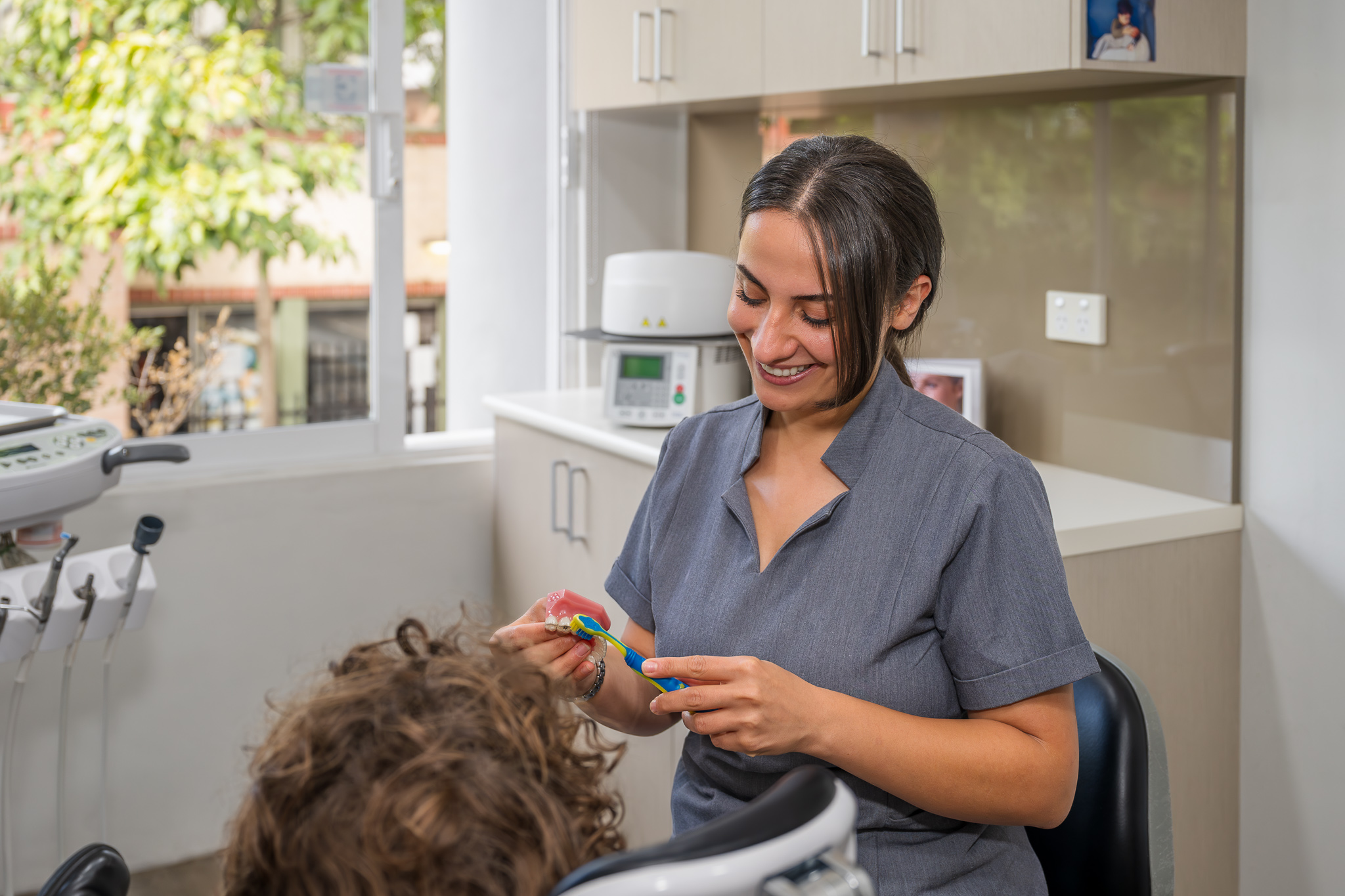
MFT is one of three early intervention therapies available at KB Village Dental, alongside Planas Treatment (which addresses jaw symmetry and early bite discrepancies) and Palatal Expansion (which widens the upper jaw to address crowding or crossbites).
These treatments are often recommended in combination. Structural problems and functional habits are usually related, and MFT frequently works alongside or before other interventions, addressing the muscle patterns that drive the issues the other treatments target.
All treatment plans are designed by Mirna Yousif and tailored to each child’s specific needs and developmental stage. If your child is anxious about dental visits, KB Village’s approach is calm and family-friendly. Nothing about MFT should feel confronting for a young patient.
KB Village Dental is located in Kirribilli, between Milsons Point and Neutral Bay, and is easy to get to from across North Sydney, including Crows Nest, Mosman, McMahon’s Point, and Neutral Bay. There’s street parking nearby, and the practice is a short walk from Milsons Point train station.
When Should You See a Dentist About Myofunctional Therapy?
The ideal window for MFT is generally during the primary or early mixed dentition phase (roughly ages 4 to 9), though treatment can start earlier or extend later depending on your child’s situation.
Waiting until all the adult teeth have arrived is often too late to correct the underlying muscle habits driving the problem. By then, those habits may have already influenced how the jaw has developed.
You don’t need a referral to book a consultation at KB Village Dental. If other professionals, such as a GP, speech pathologist, or ENT, have already flagged concerns about your child’s breathing, sleep, or speech, MFT works well alongside other treating practitioners as part of a coordinated approach.
Taking the Next Step
MFT is a gentle, evidence-informed therapy that addresses the root muscle habits behind breathing, speech, and dental development issues in children. It’s non-invasive, personalised, and designed to suit young patients.
If you’ve noticed signs in your child — mouth breathing, snoring, speech difficulties, or restless sleep — a consultation is the right starting point. Mirna Yousif and the team at KB Village Dental can assess whether MFT is appropriate and explain what a program would look like for your child.